
ECTS Conversion Table
You can examine the ECTS credits, grade point averages out of 4.00, and equivalents of letter grades used at Sivas Cumhuriyet University in a 100-point system; and calculate the approximate student workload based on ECTS credits.
1 ECTS
25–30 Hours Workload
Licence
240 ECTS
Degree
60–120 ECTS
Doctorate
Minimum 180 ECTS
Grading System
SCU ECTS Grade Conversion Table
The course grades are represented below in terms of ECTS credits, SCU letter grades, grade points out of 4.00, and their equivalents on a 100-point system.
| ECTS Grade | SCU Letter Grade | Rating out of 4.00 | Equivalent to 100 points | Achievement Level | Conclusion |
|---|---|---|---|---|---|
| A | AA | 4,00 | 100 | Very good | Successful |
| B | BA | 3,50 | 88,33 | Good – Very Good | Successful |
| C | BB | 3,00 | 76,66 | Good | Successful |
| D | CB | 2,50 | 65 | Average – Good | Successful |
| E | CC | 2,00 | 53,33 | Middle | Successful |
| FX | DC | 1,50 | 41,66 | Middle | Successful |
| FX | DD | 1,00 | 30 | Middle | Successful |
| F | FF | 0,00 | 0 | Unsuccessful | Unsuccessful |
Quick Calculation
Grade and ECTS Calculation Tools
You can view the equivalent of your SCU letter grade or calculate the approximate student workload for a specific ECTS credit.
SCU Grade Converter
Select the SCÜ letter grade to view ECTS and other grade equivalents.
ECTS Grade
—
Equivalent to 4.00
—
Equivalent of 100
—
Conclusion
—
ECTS Workload Calculator
It calculates the approximate duration based on the principle that 1 ECTS credit corresponds to 25–30 hours of student workload.
Estimated total student workload
Enter the ECTS value.
Turkish Higher Education System
ECTS Credits by Level of Education
The ECTS credit structure for educational levels within the Turkish Higher Education Qualifications Framework is as follows:.
Associate's Degree
120 ECTSTwo-year short-term higher education programs. Total student workload is approximately 3,000–3,600 hours.
Licence
240 ECTSFour-year undergraduate programs. Total student workload is approximately 6,000–7,200 hours.
Degree
60–120 ECTSThese are one- or two-year secondary higher education programs, depending on the program type.
Doctorate
Minimum 180 ECTSThird-level programs require a minimum of 180 ECTS credits.
ECTS credits are based on student workload. (Source document) 1 ECTS = 25–30 hours This is referred to as student workload.
Academic Practice
Important Notes
YT (Sufficient/Passing) Grade
A YT grade may be awarded for some courses that are successfully completed, such as projects or seminars. The YT grade is not included in the calculation of the overall grade point average.
Graduation Requirement
To graduate, students must successfully complete all courses in the program and achieve a minimum overall grade point average of 2.00 out of 4.00.
Useful Resources
Academic and Institutional Connections
This table is provided for general academic information purposes only. Course performance, academic recognition, graduation, and other academic procedures will be governed by the current Sivas Cumhuriyet University regulations and relevant academic unit decisions.
National Higher Education System
Turkish Higher Education System and TYYÇ
The general structure of the higher education system in Türkiye, its degree levels, student admission system, and the relationship between the Turkish Higher Education Qualifications Framework and ECTS are summarized below.
General Structure of the Turkish Education System
The basic structure of the Turkish National Education System consists of non-compulsory pre-school education, compulsory primary and secondary education, and higher education levels.
Primary education begins at age 5.5 (66 months) and lasts for eight years. This period consists of four years of primary school and four years of middle school. Secondary education also lasts four years and is conducted under two main categories: general high school education and vocational and technical high school education.
Administration of Higher Education
The higher education system in Türkiye is managed by the Council of Higher Education (YÖK), an autonomous public institution responsible for the planning, coordination, management, and supervision of higher education within the framework of the Constitution and the Higher Education Law.
State universities and non-profit foundation universities are established by law and are subject to the Higher Education Law and the regulations issued based on this law.
Grade and Rank Structure
In Türkiye, higher education consists of short-term, first-level, second-level, and third-level higher education programs, according to the terminology of the Bologna Process.
The Turkish higher education degree structure is generally based on a tiered system. However, Dentistry, Pharmacy, Medicine, and Veterinary Medicine programs are single-tier, long-term programs.
These single-stage programs last five years and amount to 300 ECTS credits, excluding the Medical program. Medical education lasts six years and consists of 360 ECTS credits. The qualifications obtained from these programs are considered equivalent to both first-stage (undergraduate) and second-stage (graduate) qualifications.
Associate degree programs consist of two-year full-time programs and are completed with 120 ECTS credits. Bachelor's degree programs generally consist of four-year full-time programs and are completed with 240 ECTS credits.
Graduate Education
Graduate education consists of second-level master's programs and third-level doctoral programs. Master's programs are divided into two types: thesis-based and non-thesis-based.
Non-thesis master's programs generally consist of 60–90 ECTS credits and include courses and a term project. 60 ECTS non-thesis master's programs are available in a limited number of fields.
Master's programs with thesis consist of 90–120 ECTS credits; these include courses, seminars, and thesis work.
Doctoral programs require the completion of at least 180 ECTS credits; these programs encompass the completion of coursework, passing a qualifying examination, and the preparation of a doctoral thesis.
Medical specialization training is considered equivalent to tertiary programs and is conducted in medical faculties, university hospitals, and training hospitals affiliated with the Ministry of Health.
Structure of Higher Education Institutions
Universities consist of institutes that run master's and doctoral programs, faculties that run undergraduate programs, four-year colleges with a vocational focus, and two-year vocational colleges.
The source document states that, starting in 2003, students holding a bachelor's degree can apply directly to doctoral programs if they have exceptionally high academic achievement at the undergraduate level, high scores on the national Graduate Education Entrance Examination (ALES), and their applications are accepted; these students are also required to complete an additional 60 ECTS credits in the theoretical part of the program.
Higher Education Admission
Admission of Turkish citizens to short-term (associate degree) and first-level (bachelor's degree) programs is centrally administered and based on national examinations conducted by the Measurement, Selection and Placement Center (ÖSYM).
Candidates are placed in higher education institutions based on their placement scores, which consist of their central examination scores and secondary education achievement scores.
Admission to postgraduate programs is carried out directly by higher education institutions within the framework of publicly available national and institutional regulations.
Admission of international students to programs at all levels of higher education can be carried out through direct applications to higher education institutions, within the framework of relevant national and institutional legislation.
Turkish Higher Education Qualifications Framework (TYYÇ)
The Turkish Higher Education Qualifications Framework (TYYÇ) was developed based on the European Higher Education Area Qualifications Framework (QF-EHEA) and the European Lifelong Learning Qualifications Framework (EQF-LLL) and was adopted by the Council of Higher Education in 2010.
The Turkish Qualifications Framework (TYYÇ) constitutes the higher education section of the eight-level national qualifications framework, which is intended to cover all education levels. Higher education levels are located between levels 5 and 8 within this framework.
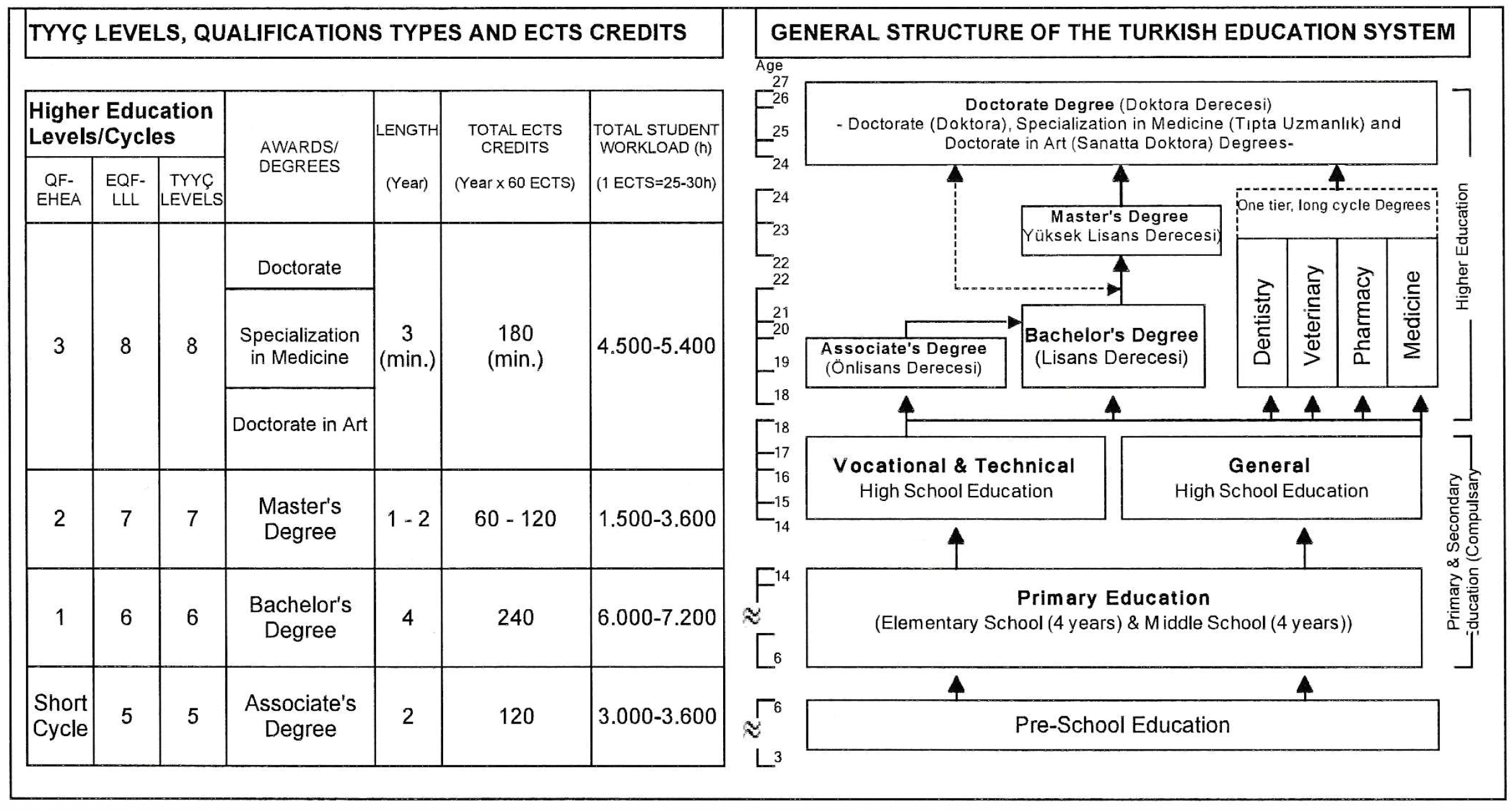
The relationship between higher education levels and European Qualifications Frameworks, ECTS credits, and student workload is shown in the table below.
Single-Stage Long-Term Programs
Dentistry
5 years · 300 ECTS
Veterinary Medicine
5 years · 300 ECTS
Pharmacy
5 years · 300 ECTS
Medicine
6 years · 360 ECTS
Turkish Qualifications Framework and ECTS
Turkish Qualifications Framework Levels, Qualification Types and ECTS Credits
Comparison of degree types, program durations, ECTS credits, and total student workload for QF-EHEA, EQF-LLL, and TYYÇ levels given in the source document.
| QF-EHEA | EQF-LLL | TYYÇ Level | Qualification / Degree | Duration | Total ECTS | Total Student Workload |
|---|---|---|---|---|---|---|
| Level 3 | 8 | 8 |
Doctorate Medical Specialization Proficiency in Art |
At least 3 years | At least 180 | 4,500–5,400 hours |
| Level 2 | 7 | 7 | Master's Degree | 1-2 years | 60–120 | 1,500–3,600 hours |
| Level 1 | 6 | 6 | Bachelor degree | 4 years | 240 | 6,000–7,200 hours |
| Short Stage | 5 | 5 | Associate Degree | 2 years | 120 | 3,000–3,600 hours |
Turkish Education System and Higher Education Levels
The diagram illustrates the general structure of the Turkish education system, from pre-school to doctoral level, and the relationships between higher education qualifications.